Welcome! Whether you are a guest, friend, or member to Arlington Street Church, Unitarian Universalist, we warmly invite you into the experience of a congregation that strives to create a community of seekers and celebrates and nurtures a broad diversity of personal spiritual journeys.
Since its founding, Arlington Street Church has been “gathered in love and service for justice and peace.” The ultimate meaning we can give to our experience together is to challenge one another to go forth from this spiritual community and work to transform and heal our lives and relationships, our community, and our world. Take a look at our beautiful church and friendly congregation, located right next to the Boston Public Garden! If you refresh the page, you’ll get a new picture!
At Arlington Street Church we want you to experience the great music, the encouraging sermons, the friendly people, and the many educational opportunities for adults and children that are a part of our spiritual community. As you browse our site, we hope you get a personal and friendly look at our congregation. But we realize this is just a web site. The best way to experience all that's here for you and your family is to visit us this Sunday! Welcome to Arlington Street Church, Unitarian Universalist!
Special Considerations for Special Needs
The Arlington Street public transit station re-opened in June 2009 and now provides handicapped access from the transit station to street level via elevators and/or a ramp. A separate part of the MBTA project created a wheelchair ramp leading from street level on Boylston Street to the church office door.
Handicapped access to the Sanctuary on Arlington Street is provided by a ramp on Arlington Street which leads to an entrance to the Sanctuary.
During worship services, and other special events, FM amplification headsets can be provided upon request. Braille hymnals are also available for Sunday services, as well as a large print version of the hymnal and each week’s order of service. Please ask an usher for assistance.
Arlington Street Church has a wheelchair accessible restroom immediately adjacent to the Sanctuary.
|
|
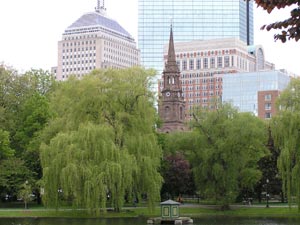 Built in 1861 as the first public building in Boston’s historic Back Bay, Arlington Street Church stands today as a pristine example of 19th century Boston architecture. Couple that with our ideal location—across the street from the Public Garden and steps fromthe Taj, Four Seasons, and the sites of Newbury Street and Beacon Hill—and it's no wonder why we’re a popular spot for weddings.
Coming Up…
Open-Sharing Worship for Katie Tyson
Saturday, September 26th, 7:15 pm, Chapel
Join us to share memories of Katie. This event is open to all.
We’ll loosely follow the circle worship style often used by UU Youth and Young Adults, but the bulk of the worship will be a time for anyone to share a favorite memory of Katie. Feel free to bring a poem, song, or story to share.
We will gather at 7:15 pm and begin at 7:30 pm. We may end by 8:30 pm, but wouldn’t be surprised if the worship ran until 9:30 pm or later (Feel free to leave whenever you need). When entering the building, please use the upstairs door at 351 Boylston Street.
~ ~ ~
A Service in Celebration of the Life of Katie Tyson
Sunday, September 27th, 1:30 pm, Sanctuary and Chapel
Please join in welcoming Katie’s parents, Karen and Herb Tyson; the Boston University community; and Katie’s many friends to Arlington Street Church for this celebration. You are invited to bring finger foods to share. Please sign up at the welcome table or by emailing welcome@ascboston.org.
~ ~ ~
Blessing of the Animals
Sunday, October 4th, 11:00 am, in the Sanctuary
Each year on a Sunday near the Feast Day of St. Francis, we celebrate the
animal companions in our lives by welcoming them (crated, on a leash, in a
bowl) to be blessed. Come join in this happy, hilarious, and love-filled
worship service.
~ ~ ~
Arlington Street Church Committee Fair!
The During Coffee Hour on Sunday, October 4th, many groups at Arlington Street Church will be represented at tables set up in the Parish Hall. Come find out about the good work that Arlington Street Church does, and perhaps discover exciting new ways that you can get involved!
~ ~ ~
New Orleans Service Trip
The week of Oct 12th, New Orleans
Come one, come all and join Reverend Kim for Arlington Street Church’s service trip to the Big Easy the week of Oct 12th. Arrive early, stay longer and enjoy the hospitality of this Rocking City! There is still plenty to do in and about the neighborhoods surrounding First Church. Most importantly, we need to be present and show our continued support for not only the members of First Church but for the residents of this city of hospitality.
Watch for updates in Inside, on the web and in Snapshot. For more information, contact Rev. Kim or email to NewOrleans@ascboston.org.
~ ~ ~
Introducing Arlington Street Church’s
New Acting Associate Minister!
The Rev. Yvonne Schumacher Strejcek comes to us from the Unitarian Church of Harrisburg, Pennsylvania.
She’s a lifelong UU who earned her MDiv from Starr King School for the Ministry in Berkeley in 2008.
She’s been a congregation president, a new congregation organizer, district president, and Acting District Exec in the UUA’s Pacific Central District. She was a board member of the UU Legislative Ministry in California and has served in numerous lay leadership positions in UU congregations and the Pacific Central District. She received three treasured awards from PCD, two for outstanding service at the congregation and district levels and one for speaking the truth with love.
Yvonne says “I cannot imagine a better use of my life now than to serve Unitarian Universalism in ministry.” She wants you to know she is feeling blessed and honored to serve this congregation, and looks forward to getting to know us. Please help her feel welcome at Arlington Street Church!
~ ~ ~
Please Donate Plastic Grocery Bags!
We are resuming our collection of plastic bags for the food pantry at Bethel Tabernacle Pentecostal Church in Dorchester. Please bring grocery sized plastic bags (not newspaper or sandwich bags) to the Social Action table after church. Supporting this food pantry is part of our Jubilee service to Bethel which sponsors the Villages without Walls youth program, funded by Jubilee, Arlington Street Church’s work in the world.
Music @ ASC
Cantabile II
Sunday October 11th, 1:30 pm, Hunnewell Chapel
Violinist Alistair Kok and pianist Rumi Naito present an afternoon recital of exquisite chamber music in the Hunnewell Chapel! Join us!
Alfred Schnittke: Suite in the Old Style
Wolfgang Amadeus Mozart: Sonata in e minor, K.304
J. S. Bach: Adagio from Concerto in c minor for violin and oboe, BWV 2060
Johannes Brahms: Sonata No. 3 in d minor, Op.108
Aaron Copland: Hoe-Down from “Rodeo”
~ ~ ~
Love Singing? Love Community?
Be part of our Arlington Street Church Choir!
Do you love to sing? Would you like to be part of a community of sharing music? Do you want or need to take just a couple hours out of your week to create something beautiful? The Arlington Street Church Choir may be just the place for you! No musical experience necessary!
We find that making music with and for our community here at Arlington Street is a central and beautiful part of our spiritual practice as Unitarian Universalists. We rehearse one night a week and sing Sunday mornings at our weekly services, performing an array of challenging, evocative repertoire spanning dozens of cultures, and centuries of musical and liturgical history.
The choir is open to all interested singers able to make a commitment to the choir’s schedule. Attendance each week is not mandatory, though members find that it’s difficult to function effectively if they miss more than a quarter of the rehearsals. We rehearse on Thursdays from 7:00–9:00 PM in the Clarke Room on the second floor of the church. If you have any questions, please always feel free to contact our Director of Music, Mark David Buckles,at mbuckles@ascboston.org.
Come join us!
ASCenter
The Wednesdays: Mary Oliver
Wednesdays, 9/23, 9/30, and 10/7, 6:00 pm – 7:30 pm, Frothingham Library
Please join Professor Alan Helms and Rev. Kim for Arlington Street’s literary salon. This fall features the work of Provincetown poet, Mary Oliver. Here’s a taste; just the first five lines of Wild Geese:
You do not have to be good.
You do not have to walk on your knees
for a hundred miles through the desert repenting.
You only have to let the soft animal of your body
love what it loves.
All are welcome!
Poems for our first meeting September 23:
“A Letter from Home”
“The Swimming Lesson”
“The Rabbit”
“At Blackwater Pond”
“Winter in the Country”
“Bailing the Boat”
“Bone Poem”
“ldquo;Last Days”
“The Truro Bear”
“Entering the Kingdom”
“Sleeping in the Forest”
“The Black Snake”
All poems come from New and Selected Poems (Beacon Press).
~ ~ ~
Sacred Eros Returns for Second Year, Adds Online Discussion
Fourth Monday of each month, 7:00 pm, Perkins Room
Experience Sacred Eros is a monthly discussion group at Arlington Street Church, providing a safe and supportive space to explore questions about sexuality from a spiritual and ethical perspective.
We meet on the fourth Monday of each month in the Perkins Room at 7:00 pm. Please enter through the side door at 351 Boylston Street. All people over 18 are welcome, and participants are expected to respect one another and keep personal matters discussed confidential.
Now in its second year, the group has also begun an online discussion list for announcements, questions and other feedback. To join, go to http://groups.yahoo.com/group/SacredEros.
Meeting dates on the ASC Web site calendar, or you can contact the group moderator through the ASC office at Office@ASCBoston.org.

New to Arlington
Street Church?
Take this 360° virtual tour of our sanctuary and chapel!
Browse our web site to learn how to get involvedat Arlington Street Church! And here are some directions to Arlington Street Church.Come visit us!
If you are new to Unitarian Universalism, this video, “Voices of a Liberal Faith — Unitarian Universalists”is a great introduction. It is hosted on YouTube, and it is ten minutes long. As of August 30th, 2009, it has gotten 79,443 views, and is rated 4 1/2 stars out of a possible 5 stars!
Worship Highlights!
It’s Sunday morning at 11:00!
Do you know where your spiritual community is?
Arlington Street’s members, friends, and guests experience worship through beautiful music, an inspiring message from the pulpit, sharing our sorrows and joys, quiet prayer and meditation.
Come and be inspired and nurtured for your spiritual journey!

Click to open the
ASC Sermon Podcast
in iTunes.
The podcast is free, but we would appreciate a donation! If you click on this button, you will be taken to our verified and secure PayPal account, and you will be invited to donate one dollar.
Thank you!
From the Pulpit
Visit the Sermonssection of Worshipfor an archive of selected sermons for the current church year.
What’s New:
Gratitude, After All
Dedicated to the memory of
Katie Tyson
[Sept. 13, 2009]
Hope
[July 12, 2009]
Life is Short.
Do it Now!
[August 2, 2009]
Forest of the Soul
[July 5, 2009]
Candles of Joy
and Sorrow
Candles can be submitted online by ASC members and friends and will be included in our weekly Candles of Joy and Sorrow ritual during the Sunday morning worship service. Click here to fill out an online Candle Card.
Stay in Touch
Arlington Street Church sends a short e-newsletter every other Friday. Called Snapshot, this e-newsletter highlights the major events in the life of our congregation and makes keeping in touch easy!
Note:Arlington Street Church takes privacy veryseriously. To learn more, read our privacy policyhere.
Sign up for Snapshot!
Social Action Opportunities
Dedicated to our heroes, Rob Compton and David Wilson, on their fifth wedding anniversary, the fifth anniversary of equal marriage in Massachusetts, for which they worked so hard.
Visit our Social Actionpage to learn how you can get involved in Arlington Street Church’s social justice work.
Friday Night Supper Program Donation Bins
The Friday Night Supper Program now has permanent donation bins in the Parish Hall located next to the piano. Donations of food items (canned vegetables, beans and soup), toiletries, and men’s clothing can be placed in these bins during the week, and will be picked up on Fridays. If you would like a tax receipt for your donated items please include your name, address, and dollar amount. Thank you for supporting the Friday Night Supper Program!
Learn more about the Friday Night Supper Program by visiting their web site.
Jubilee

Jubilee’s commitment to advancing human rights and social, economic, and environmental justice is built upon Arlington Street Church’s mission of love and service for justice and peace. Through Jubilee we aspire to share these values beyond Arlington Street Church’s walls—developing new partnerships and strengthening relationships with spiritually enriching and justice-seeking work in our local community and throughout the world.
Projects receiving our support include Only A Child, Santuario, NOLA (New Orleans) Partner Church Coordinating Committee, Partakers Prison Education, and Villages Without Walls.
